
Searching Hancock County Civil Dockets
Start at the West Virginia Court Record Access gateway. Circuit civil and Family Court matters route to WVPASS. For Magistrate civil cases, use the free MCRSearch system, which lets you search by name or case number. WVPASS's current fields cannot be confirmed. The application returns a loading error, so do not assume its form works like MCRSearch.
Use an exact case number when you have one. Otherwise, compare full party names, the Hancock location, filing date, case type, and event history. If the online record is missing or incomplete, take Circuit and Family files to the Circuit Clerk. Small claims, eviction, and other limited civil matters go to the Magistrate Clerk.
A negative result calls for a short checklist. Try the legal case style as well as the party's full name. Confirm Hancock as the location. Check whether the dispute belongs in Family Court or began in Magistrate Court. Older Circuit records may lack full electronic coverage. When calling, give the approximate filing year and the paper you want, such as a complaint, final order, or satisfaction of judgment. Those facts help the clerk locate the file without guessing at portal behavior.
- Classify the matter and choose the court.
- Open the official state route for that court.
- Search the number or complete party name.
- Read entries and events in date order.
- Request the exact judgment or filing from its clerk.
Hancock Civil Dockets Split at $20,000
Money decides the first split. Hancock County Magistrate Court holds civil jurisdiction within the current $20,000 statutory amount. It also handles small claims, unlawful entry and detainer, and wrongful occupation when title is not disputed. Circuit Court takes general civil and equity matters beyond Magistrate jurisdiction, plus appeals and anything assigned by law.
The amount is only a routing clue. Subject matter, requested relief, or an appeal can change the correct court. Older judiciary narratives sometimes quote a lower Magistrate limit, but current West Virginia Code §50-2-1 controls. Municipal courts are not general civil courts. A dispute does not land there just because it arose inside a city.
| Route | Common civil work | Search or custodian |
|---|---|---|
| Circuit | General civil, equity, appeals | WVPASS or Circuit Clerk |
| Magistrate | Claims within limit, small claims, eviction | MCRSearch or Magistrate Clerk |
| Family | Divorce, custody, support | Circuit Clerk; access limits apply |
Inside a Hancock County Civil Docket
Think of the civil docket as the index. It typically shows the court, case number, case style, filing date, status, parties and attorneys, scheduled events, filings, orders, and disposition. In an e-file case, the electronic register of actions can link to nonconfidential documents. A Magistrate result is organized into event, party-role, and docket-entry blocks.
Read the sequence rather than one lone line. A complaint starts the claim. Service and return entries show the delivery steps. An answer, motion, or counterclaim records a response. Scheduling orders, discovery notices, mediation, pretrial events, and hearings move the case along. Judgment, dismissal, nonsuit, or an agreed order may resolve it, and collection, satisfaction, or appeal activity can follow.
| Case identity | Court, number, style, filing date, type, and status. |
|---|---|
| Parties | Plaintiff, defendant, petitioner, respondent, attorney, or guardian. |
| Register entry | Date, document type, description, and filer. |
| Setting | Hearing type, date, time, room, and judicial officer. |
| Outcome | Judgment, default, dismissal, nonsuit, settlement, or appeal. |
Hancock Civil Electronic Register
The West Virginia Trial Court Rules spell this out. In an E-File Case, the electronic register of actions, associated documents, and filing receipts together form the civil docket. E-filed documents are the official court record. The Circuit Clerk must make nonsealed, nonconfidential electronic dockets, pleadings, and other documents available through the prescribed public-access route.
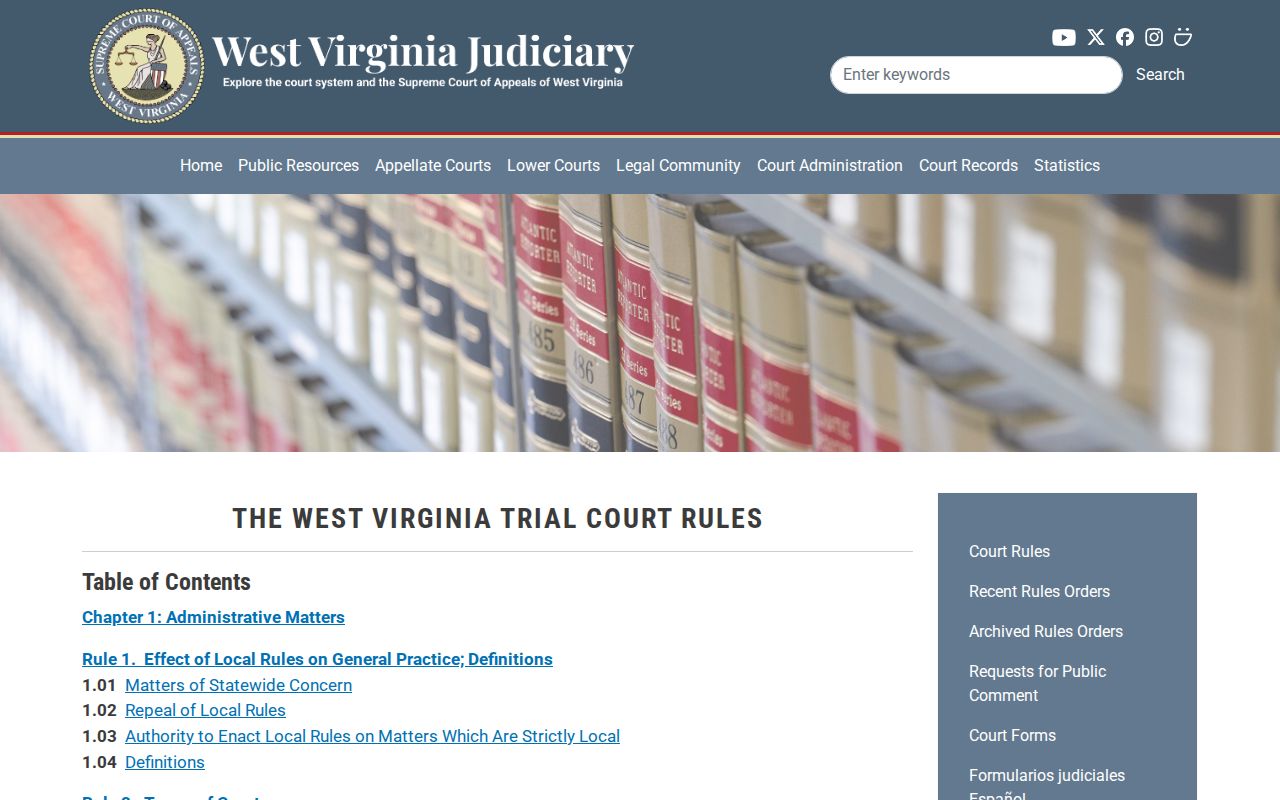
That rule page is the authority on the register's status, public access, sealing, and redaction. Not every Hancock civil paper is online. Older files may still sit on paper or in an archive. Confidential Family Court papers follow separate limits.
Docket versus document: The entry tells what was filed; the complaint, order, or judgment contains the full text.
Civil Case Types on the Docket
Circuit civil work can include general disputes, appeals, guardianship, mental-health proceedings, domestic-violence matters, and other assigned cases. Magistrate civil dockets cover small claims and possessory actions. Family Court handles divorce, custody, support, paternity, visitation, guardianship, name-change, and related domestic matters. Its records run through the Circuit Clerk's record structure.
A label alone does not decide public access. A civil case may contain sealed exhibits or protected identifiers, and most Family Court file contents are confidential even where orders and indices are public. Mental-health, adoption, and personal-safety records can carry special restrictions too. Ask for the named record. Do not request a broad topic.
- Contract and general civil claims
- Small claims within Magistrate jurisdiction
- Unlawful entry and detainer proceedings
- Guardianship and mental-health matters
- Family matters, subject to Rule 6 limits
Hancock Civil Filing Snapshot
The judiciary's 2024 statistical report lists 186 Hancock Circuit civil filings. The breakdown includes 10 appeals, 109 domestic-violence filings, and 16 general civil matters. It also lists three guardianships, eight Magistrate appeals, 36 mental-health matters, and four other domestic-relations matters. One subcolumn in the report is unclear. The reported total is safer than assigning every category.
Separate tables list 80 divorces and 151 domestic-violence filings in Family Court. They also cover 25 other domestic-relations filings. The Magistrate civil table reports a Hancock total of 437. These are filing counts for the report year. They are not counts of open cases, trials, judgments, or unique people.
Note: Filing statistics cannot reveal the result of a specific civil case.
Civil Docket Settings and Hearings
A motion line on the Hancock County civil docket is only a request. It does not mean the judge granted anything. The same caution applies to a settlement reference, which may never turn into a final dismissal or agreed judgment. What actually controls is the signed order. For an enforceable result in a Hancock County civil docket case, ask the clerk for a certified copy of the judgment or order, since the event schedule only helps you track the next hearing.
Settings come in many flavors. A listing might be a status conference, a motion hearing, mediation, a pretrial conference, a bench trial, a jury trial, or a post-judgment hearing. None of those is automatically the trial date. MCRSearch can display a case-event schedule for a Magistrate matter, while Circuit and Family settings may appear in WVPASS, an order or notice, the clerk's file, or a judge's calendar.
Read the newest open event first. Then read the most recent order. A continuance usually adds a new event rather than erasing the old one, so two future entries can sit side by side. If they conflict, call the court. The clerk will confirm the date, time, room, and location, but cannot tell you whether a party is excused or how to argue a motion.
- Setting
- A scheduled court event.
- Continuance
- An order moving the event.
- Default
- Relief may be entered after a required response or appearance is missed.
- Nonsuit
- An ending distinct from a judgment on the merits.
Request a Hancock Civil Judgment
A clear letter works best. Identify yourself. Give a return address, your delivery preference, and a phone number in case there are fee questions. Do not treat a triple seal, an ordinary certification, and a plain copy as the same thing. Say which document form you need. Ask what authentication the office can actually provide. Big requests, archived files, and records needing redaction take longer than a counter copy, so plan for that delay. One narrow request tied to a single docket entry beats a demand for the whole civil file.
An online docket printout is not a certified judgment. State the exact case number first. Add the entry date and the document title. Say whether you want inspection, a plain copy, a certified copy, or another authenticated form. Ask about current fees, payment, postage, and retrieval time before you mail any funds.
The Circuit Clerk at 102 Court Street keeps Circuit and Family records. Mail goes to P.O. Box 428, New Cumberland, WV 26047, and the phone is 304-564-3311. The Magistrate Clerk at 900 North Chester Street handles Magistrate copies. Call 304-564-3080 or 304-564-3355, or write P.O. Box 626.
Fees differ by route. A current statute lists $1 per page for certain Circuit clerk-made copies going outside the office, but an older county page lists fifty cents. Magistrate Administrative Rule 11 sets twenty-five cents per photocopy page and two dollars per fax page. Confirm the total before you send money, since certification, postage, and current practice all matter.
Older Hancock Civil Docket Files
A blank screen does not mean the case never existed. Old Hancock County civil files often sit on paper. Others rest in an archive or on microfilm. Other culprits include a misspelled party, the wrong court, a confidentiality rule, or a sealing order. Give the clerk every clue you have. That means the party or case style, the approximate filing year, the court level, and any known number. Ask whether retrieval takes advance notice.
Put any written request in plain terms: name the exact record and the format you want. Include contact details and a delivery preference. Never send sensitive personal data to an unverified email. Hancock offers no public civil-copy email or drop-box process, so phone the clerk first.
Copy rules: West Virginia Code §59-1-11 lists Circuit Clerk fees. Magistrate Rule 11 governs Magistrate copy and fax charges.
Civil Docket Access Rules
Most nonsealed, nonconfidential civil dockets in Hancock County are open to the public. A docket is not every document. Family Court Rule 6 keeps most pleadings and file contents confidential. Public orders and indices stay open, though. Sealing orders and statutes can protect other records. A redacted copy may omit personal identifiers.
If access is denied, ask why. The answer should name a rule, a statute, or a court order. You can also ask whether a public index, an order, or a redacted copy can be released. West Virginia Code §51-4-2 addresses court-record inspection and copies. The Circuit or Magistrate Clerk remains the source for verification and certified records.
One last caution. A docket can be current enough for orientation yet still lack a recently filed paper.