
Hancock County Court Calendars Explained
No single official calendar search covers every trial court in Hancock County. For Magistrate matters, a CASE EVENT SCHEDULE can appear in MCRSearch. Circuit and Family settings show up elsewhere. WVPASS, a docket entry, a notice, an order, the clerk's file, or a calendar kept by the judge's office are the usual spots. Municipal sessions stay under city control.
That split makes the case number and court name your first tools. Know which court you are dealing with. It may be Hancock County Circuit Court, Hancock County Magistrate Court, the First Family Court Circuit, or a municipal court. The date on a citation or summons is a starting record only. It cannot prove that no later reset happened.
| Court | Calendar source | Fallback |
|---|---|---|
| Magistrate | MCRSearch event schedule | Magistrate Clerk |
| Circuit | WVPASS, order, or notice | Circuit Clerk |
| Family | Order or court office | Circuit Clerk or judge's office |
| Municipal | City notice or session schedule | City court clerk |
Hancock Court Dates in MCRSearch
The official First Family Court Circuit listing lays out the route for Family Court settings. It covers the three-county office. MCRSearch works at a different court level. Its Magistrate case detail keeps the event schedule separate from the docket-entry list. Event rows may list type, date and time, room, Hancock location, judge or magistrate, and a closure reason. When past and future events pile up, either route may still need direct confirmation from the clerk.
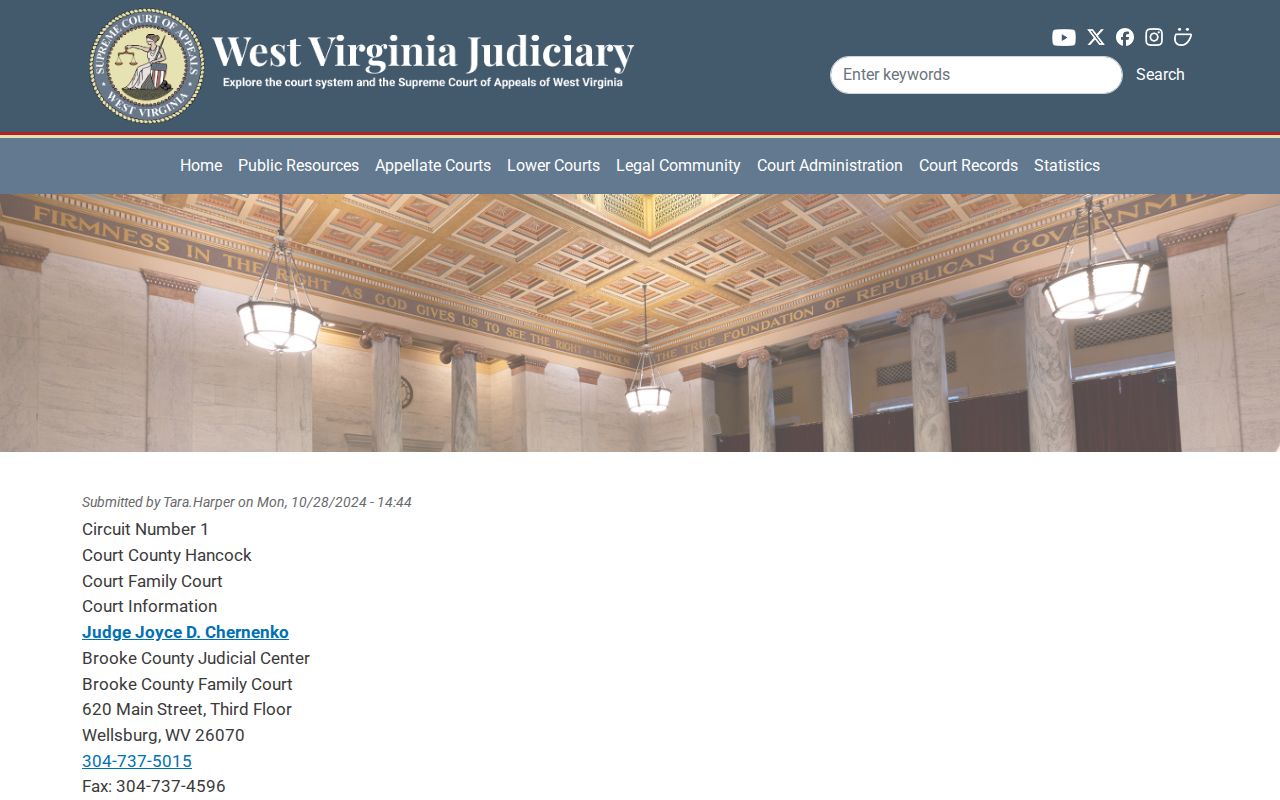
The official court listing shows the separate First Family Court Circuit contact route that serves Hancock along with Brooke and Ohio Counties. That split matters for anyone with a Family Court hearing. Confirm the location from the newest order or with the clerk, even when the Hancock filing sits inside the Circuit Clerk record structure.
Do not stop at the first date. Check newer events and docket entries for a reset.
Finding Your Court Date
No case number? A Magistrate search can start with the party's full name. Then check the Hancock location and case type. For Circuit and Family matters, hand the clerk the full case style and an approximate filing year. City tickets go back to the issuing agency named on the citation. This keeps a Weirton ordinance setting from being mistaken for a state-law ticket in Hancock County Magistrate Court.
Read the citation, summons, notice, or court order first. It may state the original time and courtroom. Next, sort the matter into Magistrate, Circuit, Family, or municipal. The Court Record Access gateway offers separate routes for Circuit and Magistrate records.
For a Magistrate case, search MCRSearch and study the event block. For Circuit or Family Court, try WVPASS. Then call the Circuit Clerk if the app is unavailable or the date is missing. City ordinance matters belong to the municipal clerk. Confirm again close to the date. Weather, closure, or a judge-specific change can shift things.
- Read the newest court-issued paper.
- Identify the court and case number.
- Check the matching official docket route.
- Find the newest open event or order.
- Call the proper clerk if entries conflict.
Hancock Court Date Confirmation Lines
For Circuit and Hancock-filed Family matters, call the Hancock County Circuit Clerk at 304-564-3311. The office sits at 102 Court Street, New Cumberland, with mail at P.O. Box 428. Family Court serves Hancock, Brooke, and Ohio Counties, so the hearing may sit in another county's office. Confirm the location before you drive.
Magistrate settings go through the Hancock County Magistrate Clerk at 304-564-3080 or 304-564-3355. That counter is at 900 North Chester Street, New Cumberland. In Weirton, call the Municipal Court Clerk at 304-797-8500 extension 1031. Chester uses 304-387-2820, and New Cumberland uses 304-564-3383.
Circuit and Family
102 Court Street
New Cumberland, WV 26047
304-564-3311
Magistrate
900 North Chester Street
New Cumberland, WV 26047
304-564-3080 or 304-564-3355
Note: Ask for date, time, room, building, and the latest controlling notice.
How to Read a Court Setting
A public setting is a bundle of fields, not just a date. Confirm the case number and court first. Then work through the event type, date, time, room, location, assigned judge, and status. A preliminary hearing is not an arraignment. A status conference is not a trial. A sentencing event follows a plea or verdict, and it should not be read as the disposition itself.
The MCR event block can show “Hearing/Event Closed” or a reason like “Motion to Continue.” Closed describes that event, not necessarily the case. When a room is listed, verify the building, because Circuit Court and Magistrate Court use separate New Cumberland addresses. Family judges, meanwhile, serve a three-county circuit.
| Event type | Hearing, preliminary hearing, status, motion, trial, or review. |
|---|---|
| Date and time | The scheduled start, subject to a later order. |
| Room and location | The courtroom and court site. |
| Judge | The assigned judge or magistrate. |
| Reason closed | Why the displayed event is no longer current or open. |
Hancock Court Terms Versus Dates
West Virginia Trial Court Rule 2.01 sets Circuit Court terms for Hancock. Those terms fall on the second Tuesday of January, April, and September. A term is an administrative period for the court's work. It is not an individual hearing date. It also does not mean every case lands on that Tuesday.
Mixing up a term date with a setting can cost you an appearance. Rely on the case-specific order, event schedule, citation, or clerk confirmation instead. The same caution applies to recurring municipal sessions. A court's regular weekly session does not put every city case on every week's docket.
Calendar rule: Trial Court Rule 2.01 sets Circuit terms; the case notice sets the individual appearance.
Continuances, Resets, and Cancellations
A date listed online may lag behind a fresh order. The clerk may have confirmed a new setting. The portal may not have caught up with it yet. Keep the newest paper and write down when the clerk confirmed the change. A reset hearing does not automatically push back every filing deadline. So read the order with care when a change touches both a hearing and a due date. The public calendar is only a convenience view. Legal deadlines belong to the court's order and the governing rule.
A continuance usually adds a docket entry instead of erasing the old one. In MCR you may see several hearing rows. "Motion to Continue" may be listed as the reason. Read the entries in time order. Spot the newest future event that is not closed. Then look for a newer order or notice.
A filed motion to continue was not necessarily granted. The judge's order controls that question. A closed event is not a dismissal either. It may simply mean the old setting ended, moved, or was replaced. When two events look active, call the clerk for the Hancock County record. Do the same if a mailed notice conflicts with the portal.
- Reset
- A new date replaces an earlier setting.
- Continuance
- A court-approved delay to a later time.
- Closed event
- An event no longer open in the schedule, not necessarily a closed case.
- Docket call
- A calendar call used to check readiness or status.
Weirton Court Dates Run Wednesdays
Weirton Municipal Court sits in Council Chambers on Wednesdays starting at 9 a.m. That schedule can change, according to the official Weirton Municipal Court page. The court hears cases processed by the Weirton Police Department and provides a payment link. Treat that vendor as a payment route only, not a full court calendar.
A standing Wednesday session does not mean your citation is set for the next one. Go by the date printed on the citation. Then confirm with the municipal clerk at 304-797-8500 extension 1031. For Chester or New Cumberland, no comparable official public calendar is posted. Call the city's route. Ask whether the ticket stays municipal or moves to county Magistrate Court. Municipal court dates do not automatically appear in MCRSearch or WVPASS.
If You Miss a Court Setting
Missing a court setting calls for quick action. Contact the court named on the citation, summons, or order right away. Give staff the case number, party name, missed date, and your contact information. Ask whether a new date, warrant, default, bond action, or other order has been entered.
When you call, ask concrete record questions. Is there a failure-to-appear entry? Is another date set? Was an order entered, and how do you get a copy? The clerk can report what the docket says. But the clerk cannot give legal advice or excuse attendance. The clerk cannot predict what the judge will do. If the office tells you to file a motion or appear, staff may explain procedure. They cannot draft the request. Nor can they suggest the legal argument to make.
Check the docket for the newest event and order. A missed setting in a criminal case can bring a capias, warrant, or bond consequence. In a civil case it can bring default or another adverse order. The right response depends on the actual order and the case type. So rely on the court and qualified legal counsel.
Act promptly. An online calendar is not authority to ignore a court-issued notice or missed-appearance order.
Hancock Calendar Is Not Outcome
A hearing row on the Hancock County docket proves only one thing. An event was scheduled or recorded. It does not show a conviction, a winning civil claim, or a dismissal. A preliminary hearing can lead to transfer. A motion hearing can produce an order. A trial setting may later move or resolve by plea or settlement.
For the outcome, read the docket entry. Also read the filed order or judgment that follows the event. MCRSearch itself warns that online information may be incomplete or inaccurate. It points users to the local clerk for validation and copies. Circuit and Family court records deserve the same care. A protected or sealed filing may never show online.